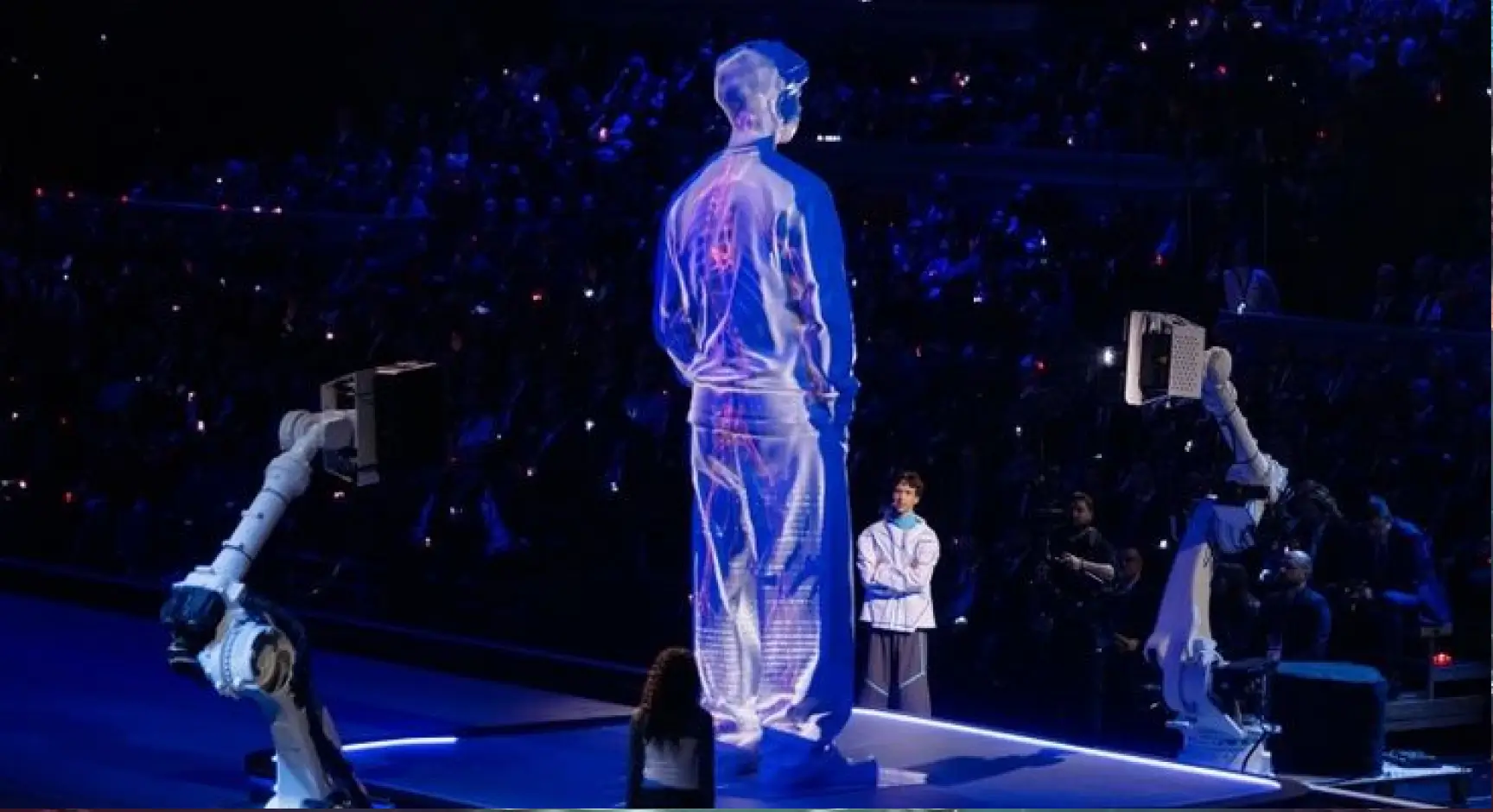
You've seen the clip. A dead rapper walks out on stage. A pop star's face floats over a stadium crowd, three storeys tall, with no screen in sight. The caption always says the same thing: "hologram". Many of these effects aren't actually true holograms.
That gap between what event tech is called and what it actually does isn't just internet sloppiness. It's the difference between two completely separate technologies that produce two completely different effects, and if you're planning an event, mixing them up can cost you a lot of money and an audience that walks away disappointed. So let's actually break down what's real, what's illusion, and what's just marketing shorthand.
Thanks to Star Wars, most people picture a hologram as a genuine 3D object made of light, floating in mid-air, viewable from any angle, with nothing behind it. That's true holography, and it's built on recording actual light interference patterns from laser beams. It exists in physics labs and in some very niche, very expensive research applications. True holography is rarely used at typical concerts, product launches, or brand activations. If someone pitches you a "real hologram" for your event budget, ask them to define their terms, because what they're selling is usually a hologram-style effect or an optical illusion.
Most of what gets called a "hologram" on stage is actually Pepper's Ghost, a technique that's over 150 years old. It was originally used in Victorian theatre to make ghosts appear on stage.
Here's how it works. A performer, video feed, or rendered CGI figure is placed out of the audience's direct line of sight, often below stage level or in a wing. Their image is reflected off an angled, transparent surface, historically glass, now usually a foil or specially coated screen, positioned between the audience and the stage. Because the reflective surface is invisible under the right lighting, the audience perceives the reflected image as if it's floating in open space on the main stage.
The illusion only works from certain angles and under controlled lighting. There's no genuine 3D object there, and there's no true volumetric depth. It's a flat image, cleverly bounced. Many modern hologram-style concert effects, and a lot of the "floating figure" moments you see in keynote presentations and awards shows, use this same basic principle, just with better screens and sharper video.
A closely related but distinct effect is the hologram fan or hologram pyramid, which uses rapidly spinning LED blades or angled reflective panels to trick the eye into seeing a volumetric shape through persistence of vision, the same principle that makes a flipbook look like it's moving. It looks more "3D" than Pepper's Ghost from some angles, but it's still an optical trick, not a true hologram, and these systems are generally better suited to controlled viewing environments than very large audience spaces.
Projection mapping is a different animal entirely, and it doesn't try to fool you into thinking something is floating. Instead, it uses one or more calibrated projectors to cast light precisely onto the actual contours of a real, physical object, a building facade, a car, a stage set, even a mountain. Specialised software maps the digital content to match every edge, curve, and surface of that object exactly, so animations, textures, and colour appear to "belong" to the structure itself.
This is what makes a building appear to crack open, a static product look like it's transforming, or a plain stage set burst into flame, without moving a single physical piece. Because it's projected light and not a physical image trapped between glass, projection mapping is far more flexible for large-scale, outdoor, or highly detailed environments. It can wrap around irregular architecture in ways Pepper's Ghost simply can't attempt.
The trade-off is that projection mapping needs a real physical surface to project onto, and it needs the right ambient light conditions, since strong daylight or competing light sources will wash it out. It also creates an illusion of transformation on a surface, not a free-floating figure in open air.
If your goal is to bring a specific figure, product, or performer to life on stage, something with a clear "presence" that the audience should feel is right there in the room, Pepper's Ghost or a hologram fan setup is usually the stronger choice. It works well for artist tributes, keynote reveals, and moments where you want a single focal point to command attention in a contained space.
If your goal is to transform an environment, a building, a stage backdrop, or an entire venue exterior and create a sense of spectacle or storytelling across a large surface, projection mapping is the better tool. It's also the more practical option outdoors or at scale, where a Pepper's Ghost setup would struggle with sightlines and ambient light.
Budget matters here too. Pepper's Ghost can be more contained for certain applications, while large-format projection mapping may require multiple high-lumen projectors, precise calibration, and a site survey, depending on the scale. Neither is inherently cheaper; it depends entirely on the scale and surface you're working with.
The honest answer for most brands is that the "sci-fi hologram" moment they're picturing is actually a strategic choice between two very different, very real technologies, both of which can look genuinely stunning when they're matched to the right use case and genuinely underwhelming when they're not.
At most events, what audiences see marketed as a "hologram" is an illusion or hologram-style display rather than true holography, and that's perfectly fine. What they're watching is over a century of illusion engineering, refined with modern LED, projection, and rendering tech, built specifically to make an audience feel something. Knowing the difference between Pepper's Ghost and projection mapping isn't just trivia; it's what determines whether your event tech budget goes toward the effect that will actually land with your crowd.
Curious what this looks like when it's built for scale? Take a look at how we approached large-format projection storytelling in our Enter Void campaign series, or check out our Projection Mapping services to see what's possible for your next activation.