
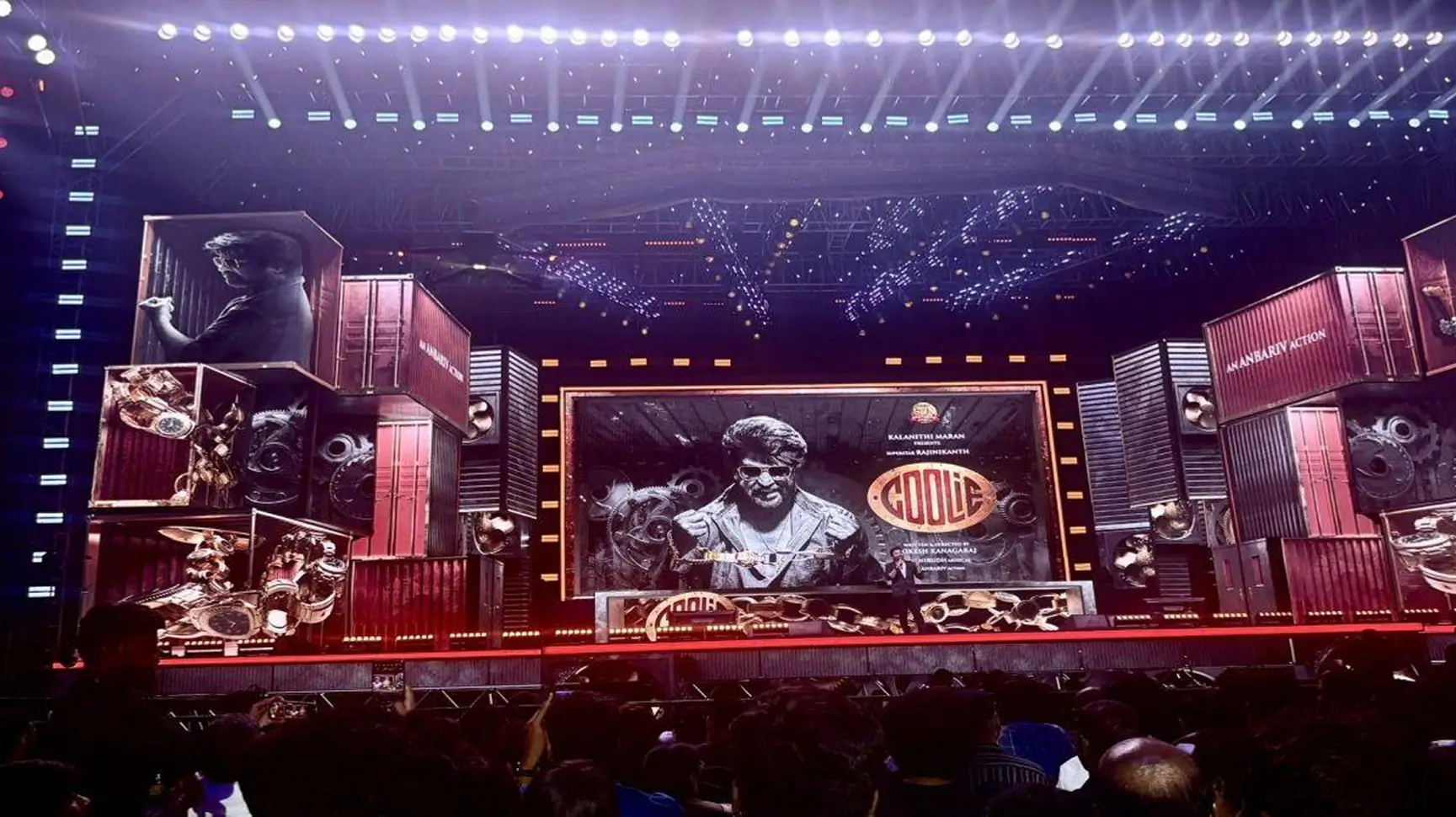
A singer steps onto a bare stage. Behind her, a dragon unfolds its wings in mid-air, huge and glowing, and then she walks straight through it. No glass. No visible screen. Just a performer and a creature that seems to float in the open space around her.
So where is the screen? Often it is a sheet of fabric thinner than a veil, or a wall of LED that you can see straight through. Both are among the most effective tools in modern 3d stage design for events, and both work by doing something screens normally never do. They disappear.
Most stage visuals sit behind or around a performer as a solid surface. Holographic mesh and transparent LED break that rule. Each lets the audience see the performer, the set and the imagery all at once, and that layering is what creates the floating look people call a hologram. Strictly speaking, neither is a true hologram, but the effect on an audience is just as striking.
They get there in different ways. One is a projection surface so fine that it almost vanishes. The other is a real LED screen built with gaps in it. The angled-glass illusions are a separate story, which we covered in 3D Holograms vs. Projection Mapping. This article stays with mesh and transparent LED.
Holographic mesh, sometimes called a hologauze or holographic scrim, is a very fine, open-weave fabric stretched flat across the stage. A projector aims at it, and the threads catch just enough of the image to show it. The gaps between the threads let everything behind the mesh stay visible.
The result is imagery that appears to hover in front of the set, with performers visible right through it. Hang the mesh vertically, tension it tightly, and keep the scene behind it carefully controlled, and the fabric itself fades from the audience’s view.
It is also surprisingly practical. ShowTex’s PepperScrim comes up to seven metres wide and weighs only about 14 grams per square metre, so it travels easily and goes up on a truss. The trade-off is that it is delicate, and the manufacturer notes it is not meant for permanent use. Because the picture sits on fabric, it also depends on the room. The brighter the stage around it, the fainter the image, so mesh works best when the surroundings are kept dark.
Transparent LED is a real LED screen, built with physical gaps between rows of LEDs. Those gaps are what let you see through it. The screen produces its own brightness, so it does not need a projector and is generally better suited to brighter environments, though strong ambient light can still reduce how visible and contrasty the content looks. Dark content helps the effect, because unlit areas add nothing to the view and the eye goes to the bright parts. Wherever the content is bright, the picture seems to float in the air.
The catch is a trade-off built into the hardware. More open space means more transparency but a coarser picture. A finer picture means less transparency and a higher price. Good stage design picks the balance for the distance the audience will watch from.
Here is the comparison that matters when you are choosing between them.
| Holographic mesh | Transparent LED | |
|---|---|---|
| Visibility | Soft, floating image that fades if the stage behind it is bright | Crisp image that generally holds up on a lit stage |
| Brightness | Limited by the projector and the room, so it needs a darker, controlled stage | Generally high, because the screen makes its own brightness, though strong ambient light still lowers contrast |
| Transparency | Very high, the fabric nearly vanishes | Varies by model and trades off against picture detail |
| Viewing angles | Cleanest from in front, weaker off to the sides | Wider, though the see-through quality shifts at sharp angles |
| Stage integration | Thin fabric on a truss, easy to transport and rig, but delicate | Rigid panels with power and data, heavier and planned into the structure |
| Best for | One big floating moment in a controlled setting | Bright venues, close viewing and repeated use |
Neither is better in general. The right one depends on your stage, your audience and the moment you are building.
Choose holographic mesh when the goal is a single, memorable floating moment: a character appearing beside the artist, a title hanging over the stage, a reveal that makes the room gasp. It works best where you control the stage and can keep the area around the effect dark.
Choose transparent LED when the stage is bright, the audience sits close, or the effect has to work show after show. It suits product reveals, brand activations, and concerts where the content must stay crisp next to full stage looks. They are not rivals either. One stage can use mesh for the large floating moment and transparent LED for sharper detail nearer the performer.
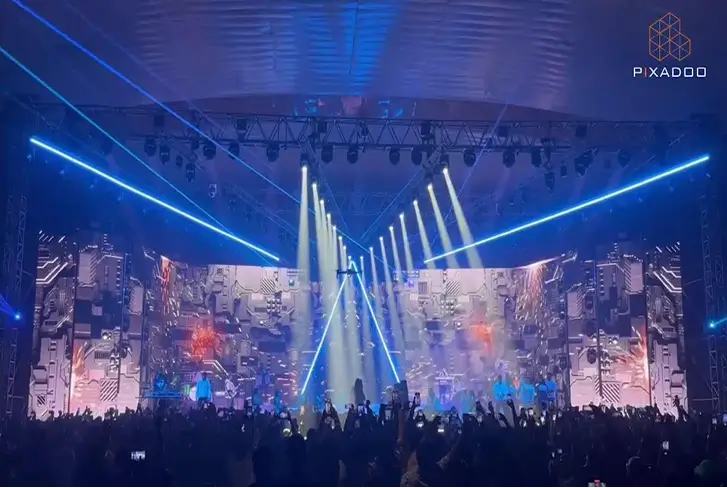
The hardware only disappears if the content lets it. On both technologies, dark areas of the artwork fade into the background, so a good design uses black the way a painter uses empty canvas. A glowing character, a ring of particles or a floating logo sits in the space. Large flat blocks of bright colour work against you, because they read as solid and cancel the illusion.
Layering adds depth. Put mesh at the front and transparent panels behind, and imagery appears at different distances, so a performer can stand between them. That sense of depth is the heart of creative event stage design, and it needs rehearsal, because the picture changes depending on where the performer stands and how the stage is lit.
Performers can interact with the effect too. Because the graphics share the same space as the artist, a dancer can reach toward a floating shape, step through an image, or seem to carry it across the stage. Timing is everything. The visuals are cued to the performer’s movement, and the choreography is rehearsed so that hand and graphic meet at the right moment.
Most failures come from the same few places. The first is bright, busy artwork, which makes a see-through screen look like a solid one. The second is placing mesh where the stage behind it is brighter than the image, so the picture washes out. The third is choosing an LED pitch without checking where the audience will actually stand, which leaves the image grainy from the front rows. The fourth is leaving rehearsal until the last day, when there is no time left to fix the tension of a fabric or the angle of a panel.
None of these is difficult to avoid. They simply need to be planned for early, which is why the stage, the content and the technology are best designed together.
If you are planning a holographic display in Dubai, start with the venue, not the effect. A few questions settle most of the decision. Is the stage indoors or outdoors? Fabric and wind do not mix, so an open-air mesh needs shelter or a different solution. How bright is the room, counting stage looks and the audience’s own phone screens? How far is the audience from the stage? And how much rehearsal time is there, since both options need testing with real performers on the real stage?
An invisible stage is really a very carefully planned one. To see how we treat media, sightlines and rigging as one system, explore our Stage Design service.